
WILLIAM GRANT STILL: TROUBLED HISTORY (part 4 of 5)
Posted on October 5, 2018
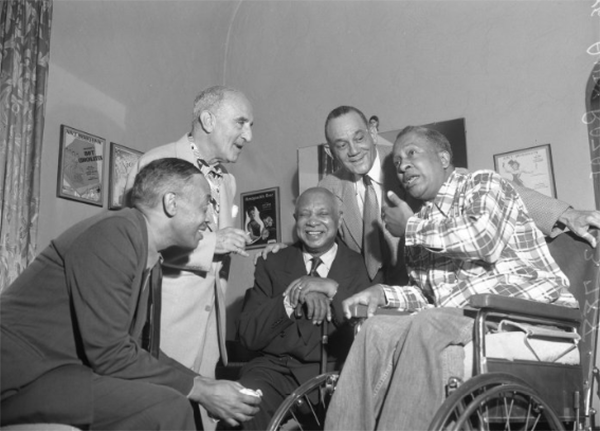
“Musicians William Grant Still, L. Wolfe Gilbert, W. C. Handy, Frank Drye and Andy Razaf in Los Angeles, Calif., circa 1954.” From UCLA Library, Islandora Repository, Los Angeles Daily News Negatives.
During the 30s and 40s, Still was at the height of his standing in the ‘serious’ music world; his compositions in many genres, including five symphonies, numerous tone poems and orchestral suites, Sahdji, the first ballet by an African-American, and many different kinds of choral works, won several awards. He received the first three of his eight eventual honorary degrees. Dearest to him of all his choral music were Still’s eight operas. The most famous, and infamous, of those is Troubled Island; it proved to be a turning point in his life.
Based on a play by Langston Hughes, Troubled Island concerned the Haitian Revolution and its first leader, Jean-Jacques Dessalines. Its libretto was begun by Hughes and finished by Arvey in 1939, when Hughes and Still parted company over political differences, and Hughes went off to cover the Spanish Civil War. Finally published under all three of their names in 1941, it took eight years of rejection and negotiation to arrive at a premiere.
The opera’s production by the New York City Opera was again a historic first: the first opera composed by an African-American to receive production in the United States at all, much less by a major company. Still envisioned that “…with a successful opera, [his family] would have the prestige to get recordings of all the music, in spite of the bigotry rampant in the major recording companies. Now they would have money that they had not had heretofore…”(J. A. Still, quoted in DjeDje, 2011). Expectations and stakes were high.
Troubled Island’s opening night was a huge success, with 22 ecstatic curtain calls over “a flood of applause.” Nevertheless, critics were surprisingly mostly neutral to negative in their reception. After it closed, Still couldn’t get another production anywhere; the State Department, which had previously promoted Still’s music, withdrew the recording from radio stations in Europe in 1950 without explanation (it was not performed in its entirety again until 2013, when it was given one performance by the South Shore Opera Company of Chicago). Performances of his other works suddenly declined as well.
This extreme disappointment led Still into the most controversial and damaging period of his life. There is some evidence of a concerted effort on the part of critics and others in the classical music community to sabotage Troubled Island, either because of straight racism or because of Still’s conservative, anti-communist politics (as opposed to Hughes’s connections with the Communist Party).
In 1951, in frustration and despair over losing almost all his musical professional momentum, and concern that Communist operatives, in partnership with ‘European’-modernist-influenced American composers, were plotting against truly ‘American’ music and “duping” the Black community, Still asked to testify to McCarthy’s House Un-American Activities Committee and was refused. He then ‘named names’ publicly in a 1953 speech to the San Jose, California, Chamber of Commerce.
As Leon Botstein described,
...perhaps Still’s worst sin, from the perspective of white and black America, was his outspoken anti-communism during the postwar era, which made him something of a pariah, particularly in liberal white circles. His politics were the polar opposite of Paul Robeson, the famous and still revered singer who was the victim of virulent anti-communism and racism, a proud progressive for whom the Soviet Union was not an evil empire, but perhaps the very opposite. In the 1950s, during the nascent years of the civil rights movement, the effective alliance was between liberal and progressive white America that had severe doubts about the saber rattling and arms race of the Cold War, and the leadership of the black community. [William Grant Still], in what was considered to be an appalling betrayal of black American progressivism at the time, sided with the enemy by embracing the traditions of a rigid, suspicious, and somewhat intolerant anti-communism…(Botstein, 2009)
Still’s national professional career plummeted further from here on. Yet he and Arvey raised their family in Los Angeles and maintained a vibrant social life in this time. Judith Anne Still relates,
…he wrote his finest orchestral pieces for children [including The American Scene]… three more grand operas, two more symphonies, and many… other works [including the prize-winning The Peaceful Land]. In addition, he and Verna Arvey lectured in the schools, served on municipal boards, and continued important correspondence with scholars and writers across the country. They were heard on Los Angeles radio stations and appeared on television. They attended meetings of ASCAP, of the American Federation of Musicians, of the NAACP, of the National Association of Negro Musicians…. They had hundreds of friends….William Grant Still received awards and invitations from all of the African-American cultural groups in Southern California [and after a 17-year dry spell, received the rest of his eight honorary doctorates]…
….Poor they were, and shunned they were, from 1950 to 1987, by opera companies, record companies, artistic directors and the media [italics mine], but they never lost their kindness and humanity, and they never gave up on the goal that they had set for themselves—to bring interracial understanding to the nation. (J. A. Still, commentary on Catherine Parsons Smith, WGS website)
Whatever one thinks of Still’s anticommunist actions, he was true to his beliefs throughout his personal and professional life; he never compromised for the sake of expediency or career advancement. His music and words represented his truth from beginning to end, and he both reaped the rewards and paid a high personal price.
Click here to read part five, the final entry of the series.
Carolyn Talarr
Community Programs Coordinator
0 Comments :