
WILLIAM GRANT STILL (part 1 of 5)
Posted on October 12, 2018
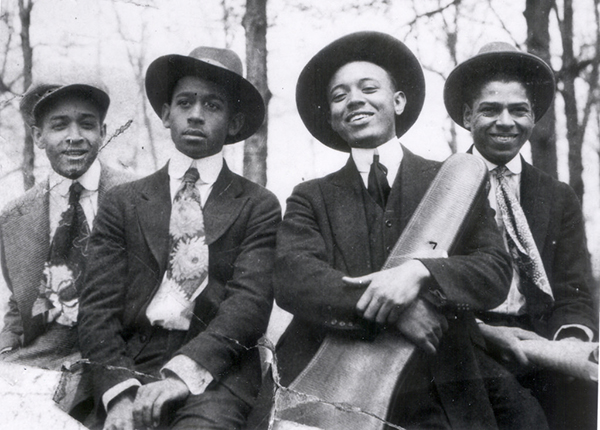
William Grant Still (with instrument case) with his friends at Wilberforce University, 1915. Photo from the holdings of the University of Arkansas Libraries’ Special Collections.
William Grant Still (1895-1978) is known as “The Dean of African-American Composers”, for good reason. The standard sites and survey history books cite the same litany of impressive firsts:
—the first African-American to conduct a major American symphony orchestra,
—the first to have a symphony (his First Symphony) performed by a leading orchestra,
—the first to have a grand opera performed by a major opera company,
—the first to have an opera performed on national television,
—the first to conduct a major symphony orchestra, the New Orleans Philharmonic, in the Deep South
Along with multiple honorary doctorates, abundant commissions, and two Guggenheim Fellowships, all these landmark accomplishments suggest a blessed, prolific career flowing smoothly from recognition to recognition. Still’s lived reality was far rockier, however, and the fate of his work, as with almost all art, was completely enmeshed in the complex racial and cultural politics of his time.
We are extremely lucky to have an abundance of Still’s writings and speeches. He communicated in words as he did in music, presenting nuanced ideas in an unaffected, understandable way that talks neither above his audience, nor down to them either.
When at all possible, I’ll be quoting Still’s own words, or those of his wife Verna Arvey, or his daughter, Judith Anne Still, or granddaughter, Celeste Headlee, as well as various scholars. This series of entries will cover different periods of Still’s life and work. Sources will be referred to in an abbreviated form in the body of the entries, and fully identified at the end of the last blog entry.
Finally, of course Still was only one of many African-American composers for the concert hall who came before and after him, each with their own particular perspective, such as R. Nathaniel Dett, who studied at Harvard, later with Nadia Boulanger, and earned a masters from Eastman; the prolific Florence Price, who graduated from the same Little Rock, Arkansas high school Still would, and was the first African-American woman to have a composition played by a major orchestra; and William Levi Dawson, whose gorgeous Negro Folk Symphony premiered in 1934. Of necessity, however, this extremely *brief* overview will have to focus on Still’s life and career in particular.
William Grant Still, who was of not only African-American, but also Spanish, Native American, and Scots-Irish ancestry, was the first generation of his family not born into slavery; one of his ancestors, William Still, was a famous African-American abolitionist and conductor on the Underground Railroad. Born in Mississippi to two high school teachers, he grew up with all the expectations attendant to being a ‘teacher’s kid.’ His parents were also very musically inclined; his grandmother would sing him spirituals.
After William’s father passed, his mother moved the family to Little Rock and remarried. The family “lived in a comfortable middle-class home, with luxuries such as books, musical instruments, and phonograph records…” (WGS, “My Arkansas Boyhood”). Still’s stepfather collected and played ‘Victor Red Seal’ records, which was a premium label representing the highest level of classical performance including opera, and took him to stage shows, where young William fell in love with the stage. His life in Little Rock, which would become infamous for its segregation and resistance to school integration, was unusual for the time:
It is true that there was segregation in Little Rock during my boyhood, but my family lived in a mixed neighborhood and our friends were both white and colored. So were my playmates…So, while I was aware of the fact that I was a Negro, and once in a while was reminded of it unpleasantly, I was generally conscious of it in a positive way, with a feeling of pride….my association with people of both racial groups gave me the ability to conduct myself as a person among people instead of an inferior among superiors. (WGS, “Boyhood”)
His mother continued to encourage literacy in her community and took other active roles in social/cultural leadership, while planning for her son to become a doctor and community leader as well. Still thus dutifully enrolled in Wilberforce University, the nation’s first private historically black university, for pre-med studies. Nevertheless, he spent most of his time in music ensembles and spent his money on instruments.
When Still eventually decided that he wanted to be a professional composer, his mother was initially extremely upset because, as he wrote, “in her experience, the majority of Negro musicians were disreputable and were not accepted into the best homes.” As he reflected later, though,
She lived long enough to know that my initial serious compositions had been successful, and her pride knew no bounds. Although she had opposed my career in music, she finally understood that music meant to me all the things she had been teaching me: a creative, serious accomplishment worth of study and high devotion as well as sacrifice. She knew at last that the ideals which she had passed on to me during my boyhood in Arkansas had borne worthy fruit. (WGS, “Boyhood”)
Indeed, the progress of Still’s composing style seems to have been integrally motivated by a series of social ideals, his approach to music determined by what he felt to be the highest calling of his life in each period.
Click here to read part two of the series.
Carolyn Talarr
Community Programs Coordinator
0 Comments :