
AMY BEACH and THE “GAELIC” SYMPHONY (Part 8 of 9)
Posted on October 2, 2019
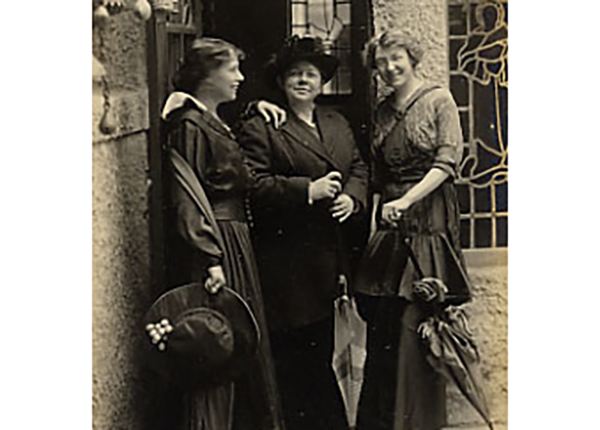
Amy Beach and friends, around 1912, in Europe. Special Collections, University of New Hampshire Library, Durham.
PYP performed Amy Beach‘s Gaelic Symphony on Saturday, November 9, 2019, at the Arlene Schnitzer Concert Hall. Click here to watch our performance.
Performance History of the “Gaelic”
The premiere performance – actually, even the *dress rehearsal* — of the “Gaelic” by the Boston Symphony, under Emil Paur, to whom Beach dedicated the piece, was received with “uncontrolled enthusiasm” from the audience. Critics agreed that the symphony was ”a genuine symphony – a real, soulful masterpiece”, and even more important, “no less full of intellect than of vocative power”. Another called it “manful” (I didn’t even know that was a word until I saw it here!). Keeping in mind the stereotyped gender characteristics attached to male and female composition, this was high praise indeed for a woman attempting the most male of musical forms.
The male-oriented praise appeared in other reviews, as one critic wrote that the symphony “never falls into triviality, but is steadily high-reaching, dignified and virile, and of an able musicianship that is beyond all question.” Another, while agreeing that the work “has not the slightest trace of effeminacy, but is distinctly and thoroughly masculine in effect”, had to find some way to tie it negatively to women: he wrote that he found its ‘noisy orchestration’ characteristic of “the scoring of most women composers.” (As Block comments sarcastically, “How many symphonic works by women composers could these critics have known?”)
Block describes women’s response to the symphony:
“Women recorded Beach’s triumph with pride. A review in the suffragists’ Woman’s Journal stressed the intellectual and ‘scientific’ aspects of the work as it had with the Mass, referring to its more lyrical side only at the end: ‘ We recognize with profound respect and admiration the intellectual power in conception, the technical skill in orchestration, and that rare inner sense of tone-color and picturesqueness belonging only to the sensitive musician, which united have produced a composition dignified and in many aspects touchingly beautiful and inspirational.” (Block, p. 102, italics mine)
With this symphony Beach had now established that a woman could be, as George Whitefield Chadwick famously proclaimed, as “one of the boys”. But how did the “Gaelic” aspect fare? Most critics addressed it far less than the groundbreaking woman-composer angle. Those who did pretty much missed it, saying that “She has called it ‘Gaelic’ and justified the epithet by the use of some melodies with Irish rhythms and turns, but the task of stamping the whole work with a [Gaelic] spirit…seems to have been beyond her powers.” (Block, 101).
Not just “beyond her powers”, but irrelevant to her goal: as both Beach’s own description and the analysis of many critics including Gerk attest, Beach wasn’t aiming to recreate an entire symphony into an Irish folk song, but rather bringing old folk tunes into the realm of the symphonic. The nuances of Gaelic folk-music as a kind of American nationalism or even Gerk’s “transnationalism”, were not discovered until years later.
In the first years after 1896, the “Gaelic” was offered by the top orchestras in the country. After its novelty wore off, it hibernated in the US after about 1905. When Beach went to Europe, she set about figuring out how to get it performed; she found American Theodore Spiering (who was appointed to take the conducting post at the Portland Symphony, but unfortunately died suddenly just before he could) who “was sympathetic to both American composers and women” (Block). His performances of the symphony earned extremely positive reviews in Leipzig and Hamburg; those reviews along with the reviews of her piano concertizing allowed her to make a triumphant return back to the States.
In early 1915, Leopold Stokowski conducted the symphony in Philadelphia, almost a re-premiere after an interval of ten years. He wrote Beach a beautiful appreciation of the work, saying it was
“so full of real music, without any pretense or effects that are plastered on from the outside, but just real, sincere, simple and deep music; and one can only say that of about one percent of contemporary music.” (Block, p. 200).
He must have meant what he said, because he programmed it again just three years later.
New York wasn’t as friendly as Philadelphia had been, however; perhaps because the community was used to cutting-edge early 20th-century modernist music, the Times critic found her work “derivative”. Brown suggests that this may have been the first evidence of the musical ‘times’ moving past Beach. Block relates that Beach never performed publicly in New York again.
Between about 1918 and 1930, the “Gaelic” hibernated once more, but re-emerged during the Depression, for a fascinating reason. Block describes:
“The Great Depression [brought] a turning away from the radical avant-garde in music and toward an ‘American’ style – in particular one based on Anglo-American folk tunes – and … there would be a renewed audience for Beach’s more conservative as well as her folk-based music….As a result, the “Gaelic” Symphony, forgotten during the 1920s, made a comeback in the 1930s and 40s [with several performances across the country]. None of those orchestras, however, were among the majors, in contrast to those orchestras that had given the symphony from 1896 to 1918.” (Block, p. 256)
After Beach’s death, her works, including the “Gaelic”, oddly, and sadly, disappeared. Since the composer herself was no longer there to support them, they were trampled under mid-century American modernism and rediscovered only in the late 1970s and 80s by Adrienne Fried Block and other feminist music scholars. There have been several performances in and around Beach’s 150th birthday in 2017, notably conducted by JoAnn Falletta who has championed reviving Beach and adding her to the canon, so that her work can be appreciated for itself rather than as being “by a woman”.
NEXT: Part 9: Conclusion
Learn more in our in-depth program notes:
- Part 1: Introduction - Amy the Pianist
- Part 2: Amy the Composer
- Part 3: Amy the Composer (Continued)
- Part 4: Amy and Her Contemporaries
- Part 5: Amy and Her Contemporaries (Continued)
- Part 6: The “Gaelic” Symphony
- Part 7: The “Gaelic” Symphony (Continued)
- Part 8: Performance History of the “Gaelic”
- Part 9: Conclusion
0 Comments :